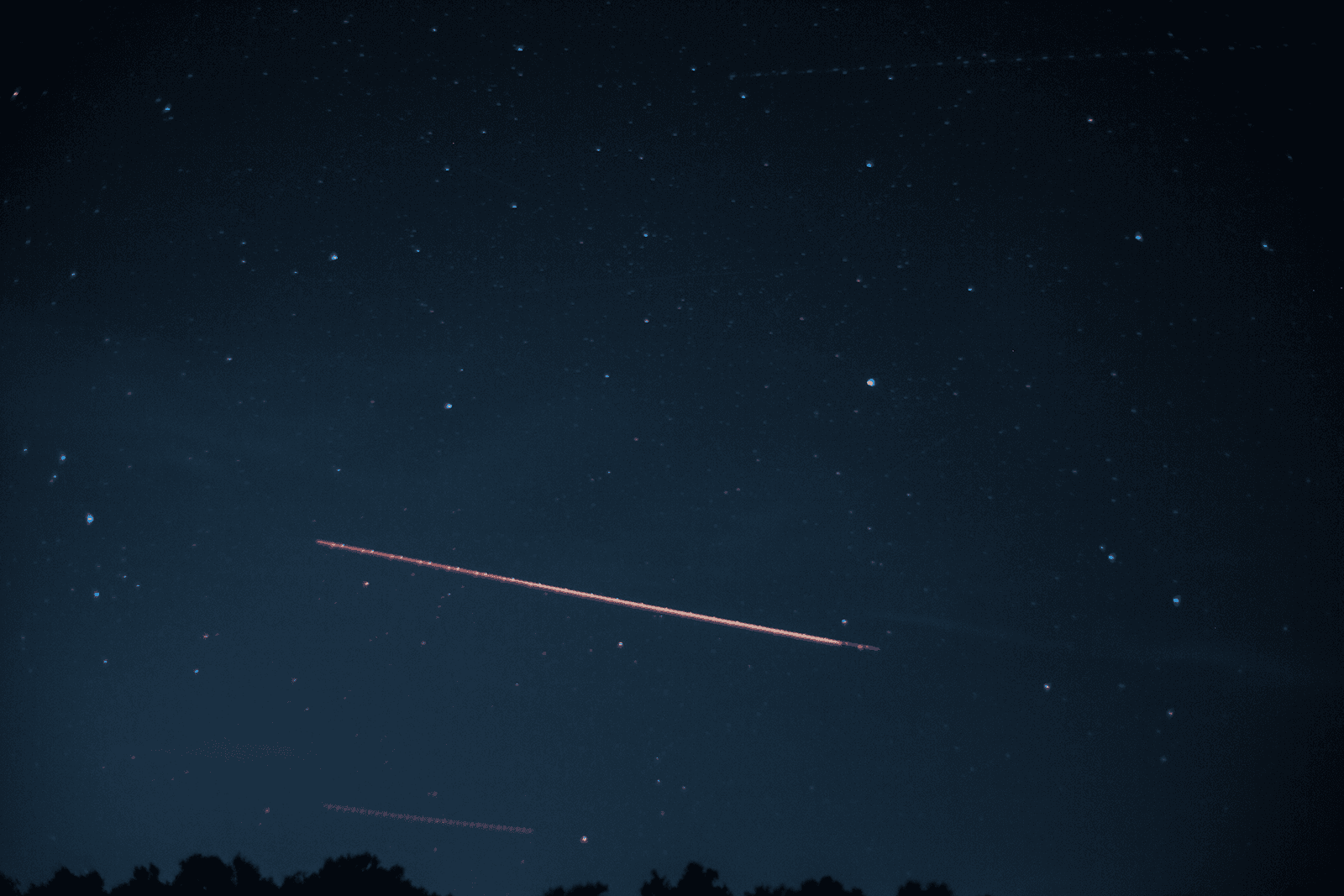
I had been wanting to get out of the city with the Canon for a while. Saturday night, June 6th, the stars lined up - literally. I drove about an hour northwest of Minneapolis to join the Minnesota Astronomical Society for one of their public Star Parties at Eagle Lake Observatory near Young America, MN.
Spoiler: it was worth every mile.
What Is a Star Party?
If you have never been to one, a star party is essentially a gathering of astronomy enthusiasts who bring their equipment to a dark-sky site and spend the evening observing together. The MAS hosts these events every other Saturday night from March through November at their Eagle Lake Observatory. They are open to the public, no membership required.
What makes it special is the community. Most of the people who show up with serious equipment are genuinely happy to share their eyepiece with a stranger. I had several conversations with folks who have been doing this for decades, and not one of them made me feel like an outsider for showing up with a camera and no telescope of my own.
The MAS website is at mnastro.org if you want to find out when the next event is.
One Request: Keep Your Headlights Off
Before I get into the photos, this is important. When you arrive and when you leave, please turn your headlights off. Use your parking lights only, or wait for your eyes to adjust and go slow. White light absolutely kills night vision, and it takes 20 to 30 minutes to recover fully. It is not a rule posted on a sign - it is just courtesy that the regulars observe, and they will appreciate you doing the same.
The Camera Setup
I brought my Canon 5D Mark II with a 28mm lens, shooting at f/2.8. I used a 30-second exposure throughout, ISO on auto, tripod-mounted with a 2-second shutter delay so my hand pressing the button would not cause any shake when the exposure actually fired. It is a simple but effective approach for this kind of work.
The Photos
Looking East - High Elevation
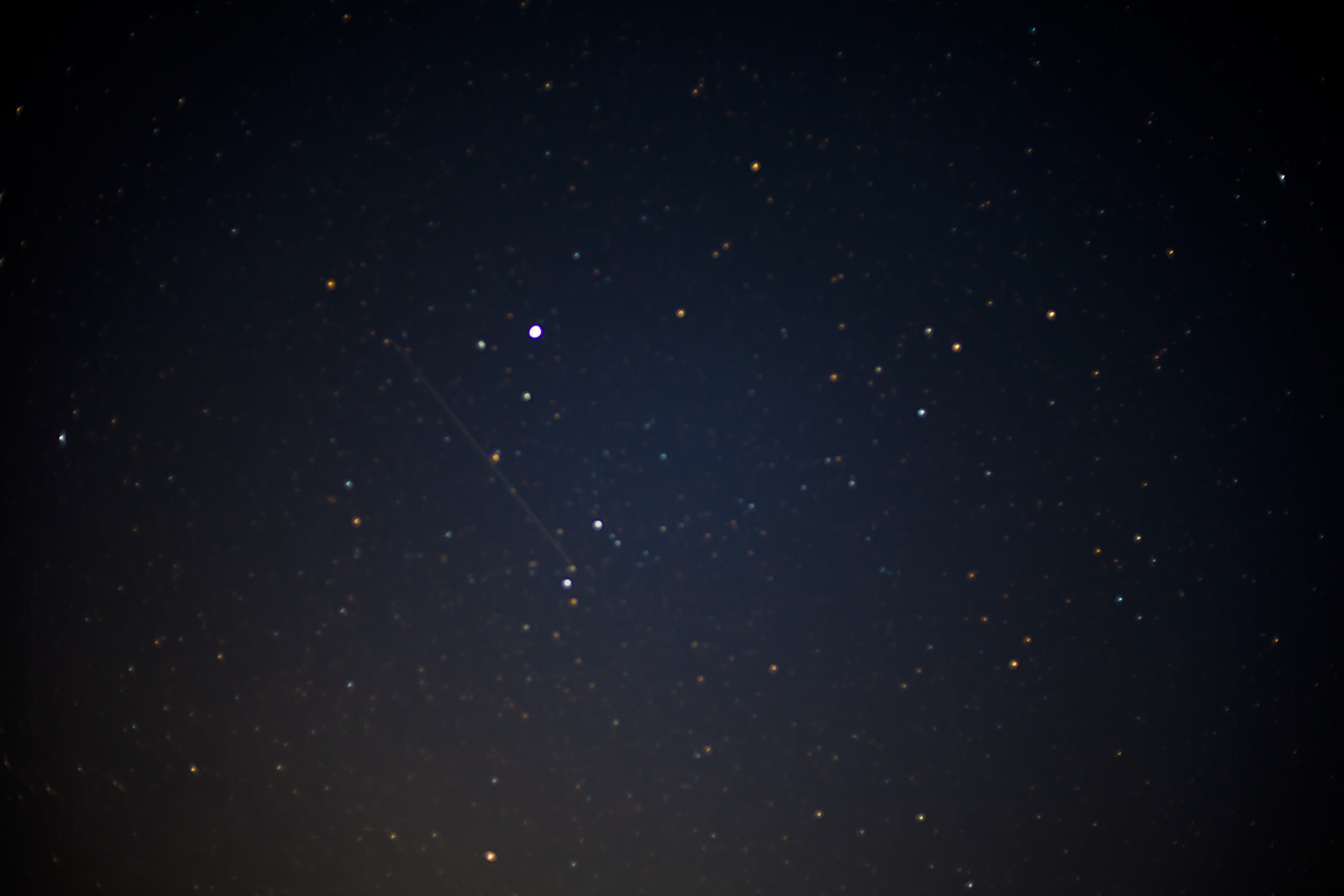
This was my first frame of the night, pointed east and high above the horizon. The most striking thing about this shot is how many stars showed up that I simply could not see with my naked eye. The brightest point in the upper left is almost certainly Vega - the lead star in Lyra and one of the three bright anchors of the Summer Triangle, which climbs high in the east on early June evenings. The diagonal streak cutting through the frame is a satellite pass, caught mid-orbit during the 30-second window.
What I find remarkable every time I do this is the color. Your eyes average stars into white dots. The sensor does not. You can see warm orange-red stars and cool blue-white ones scattered across the same field - each one a different story in terms of age, temperature, and distance.
Looking East - Lower Elevation
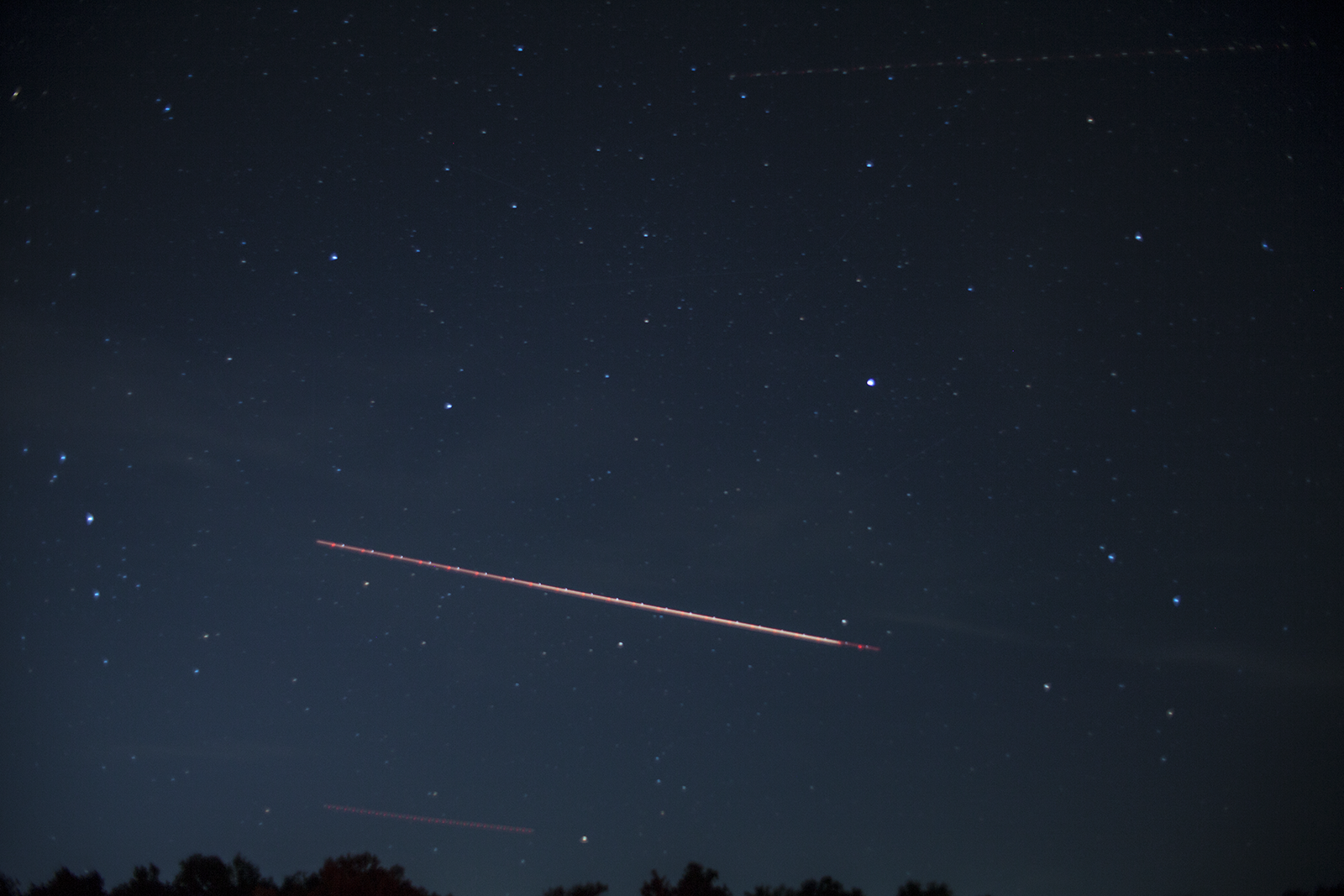
Same direction, lower angle, with the treeline visible at the bottom of the frame. This shot has the most visual drama of the bunch. That red trail cutting diagonally across the middle is an aircraft - and the reason it looks segmented rather than solid is the strobe and anti-collision lights blinking during the 30-second exposure. The solid portions are the steady navigation lights; the bright flashes are the strobes firing. You can actually count the blink rate if you look closely.
The treeline gave this shot something the others do not have: a sense of place. Looking east and low in early June puts you toward where Cygnus, the Northern Cross, is rising - an area rich with stars because you are looking toward the plane of the Milky Way.
Looking Northwest - Just Over the Treeline
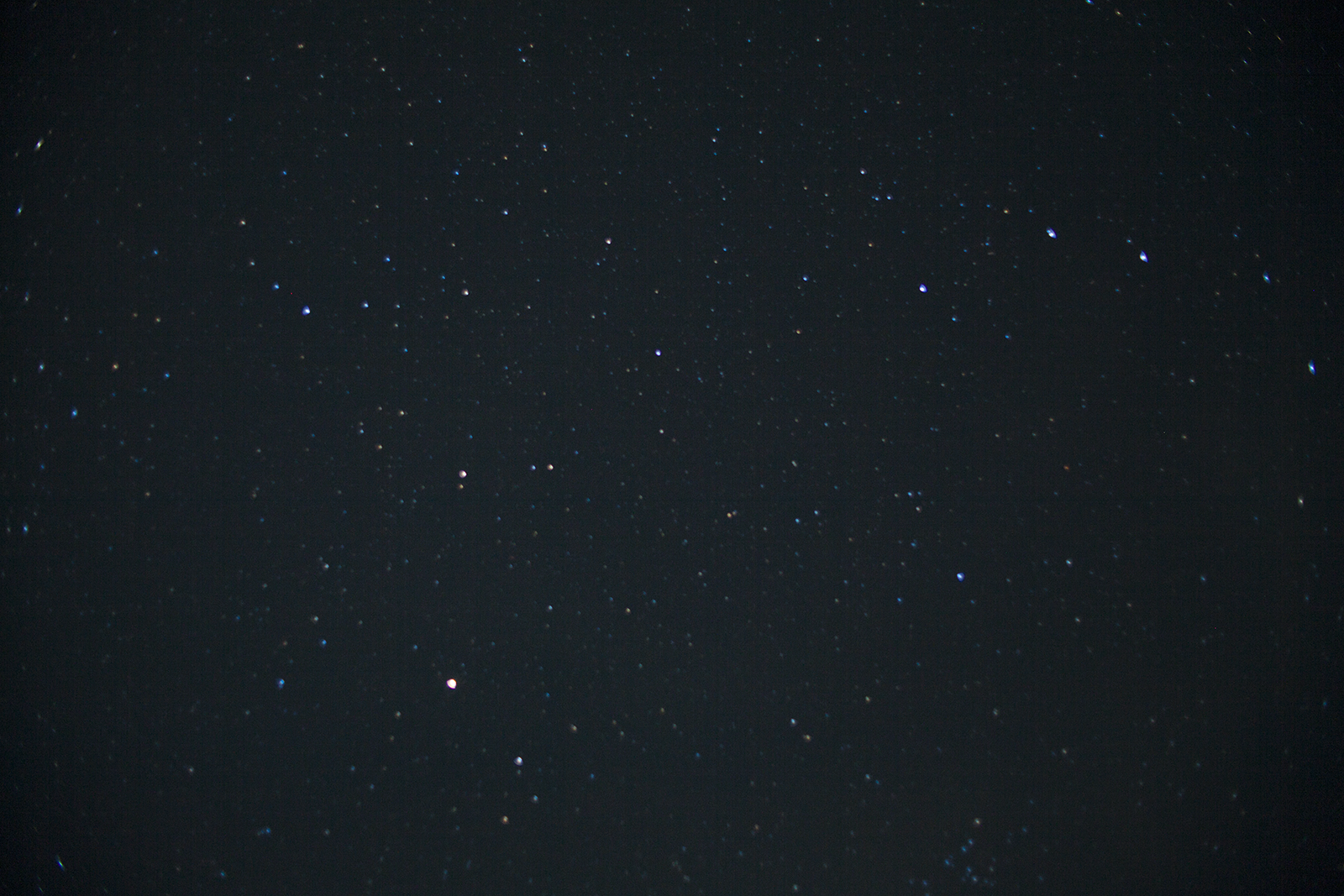
Turning northwest and dropping the camera low, I caught a wide arc of stars in the upper portion of the frame that is almost certainly the handle of the Big Dipper - part of Ursa Major, which sits in the northwest and descends toward the horizon as the night goes on. The brighter star toward the lower left is likely Capella in the constellation Auriga, which sets in the northwest in early summer.
The sky has a noticeably different tone in this frame - more of a teal-green cast. That comes from airglow, a faint natural luminescence in the upper atmosphere that is invisible to your eyes but shows up in long exposures. It is not light pollution. It is the atmosphere itself quietly glowing.
Looking Up
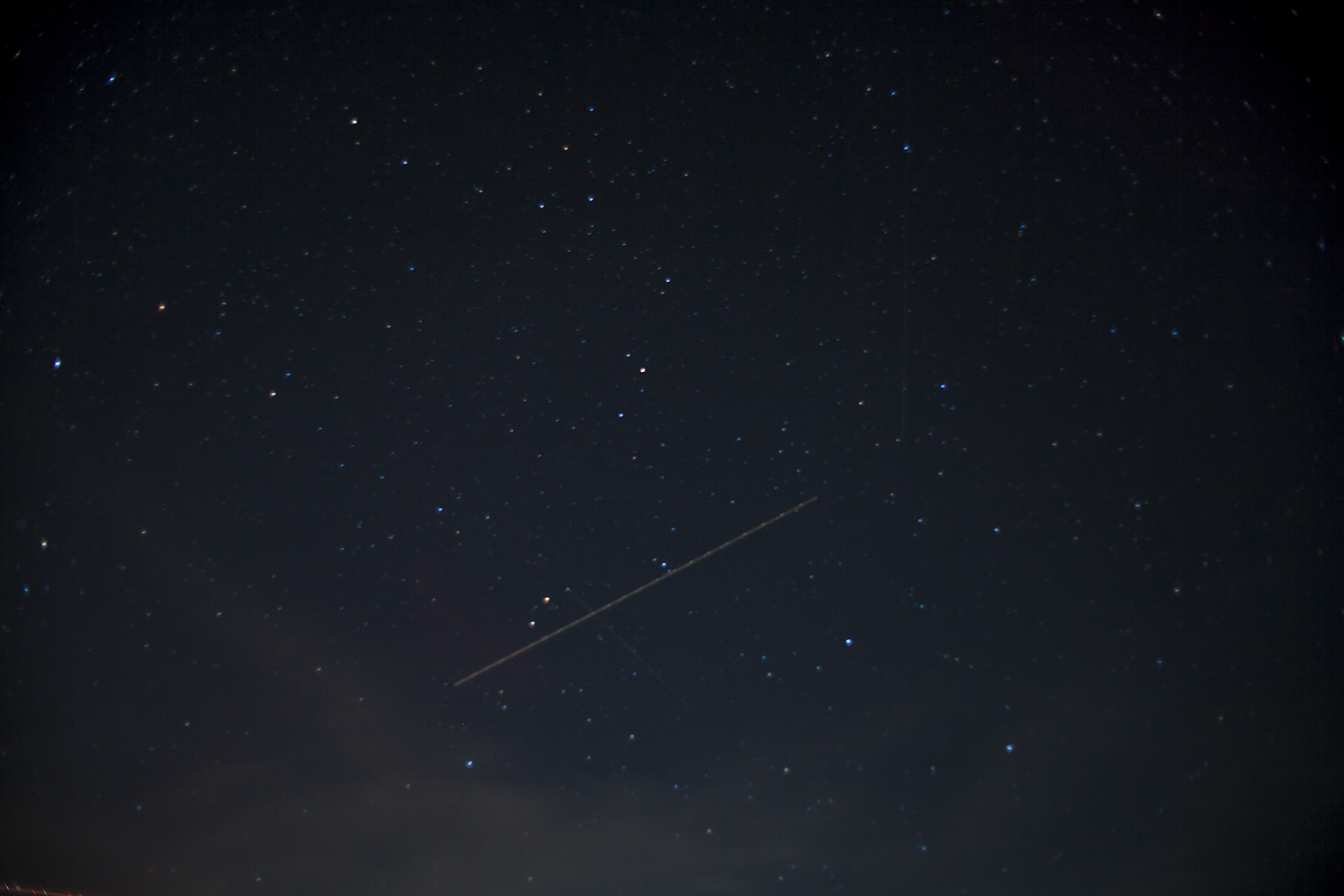
Sometimes you just point the camera straight up and see what comes back. This frame gives you a sense of the overall sky density that night - wall-to-wall stars with a faint streak from another passing satellite. The sky overhead is always the darkest part of the frame because you are looking through the least amount of atmosphere, and it shows.
The Observatory Telescope
One of the highlights of the evening was getting a look through the main telescope inside the observatory building itself. It is a significantly larger instrument than anything most amateurs own, and the MAS members on hand were happy to walk people through what they were seeing. If you come out expecting just a field of strangers with their personal gear, you will be pleasantly surprised.
I Did Not Stay for the Moon
One thing I will note honestly: I left before the moon rose. The timing did not work out for me to stay that late. So these photos are all under a true dark sky - no moonlight washing out the fainter stars. If the moon is a priority for you, check the lunar calendar before you go.
Final Thoughts
I grew up in rural North Dakota under genuinely dark skies, and I have never quite gotten used to how much the city takes away from the night. Drives like this are a reminder of what is still out there, less than an hour from home, on any clear Saturday night when the MAS is holding a Star Party.
If you want to know whether it will be clear before you go, the cloud cover overlay on the Solar Ruler home page is what I use to plan these trips.
"When I consider Your heavens, the work of Your fingers, the moon and the stars, which You have ordained, what is man that You are mindful of him, and the son of man that You visit him?" - Psalm 8:3-4 (NKJV)
All photos taken June 6, 2026, near Young America, MN. Canon 5D Mark II, 28mm f/2.8, 30-second exposure, auto ISO, tripod with 2-second shutter delay.