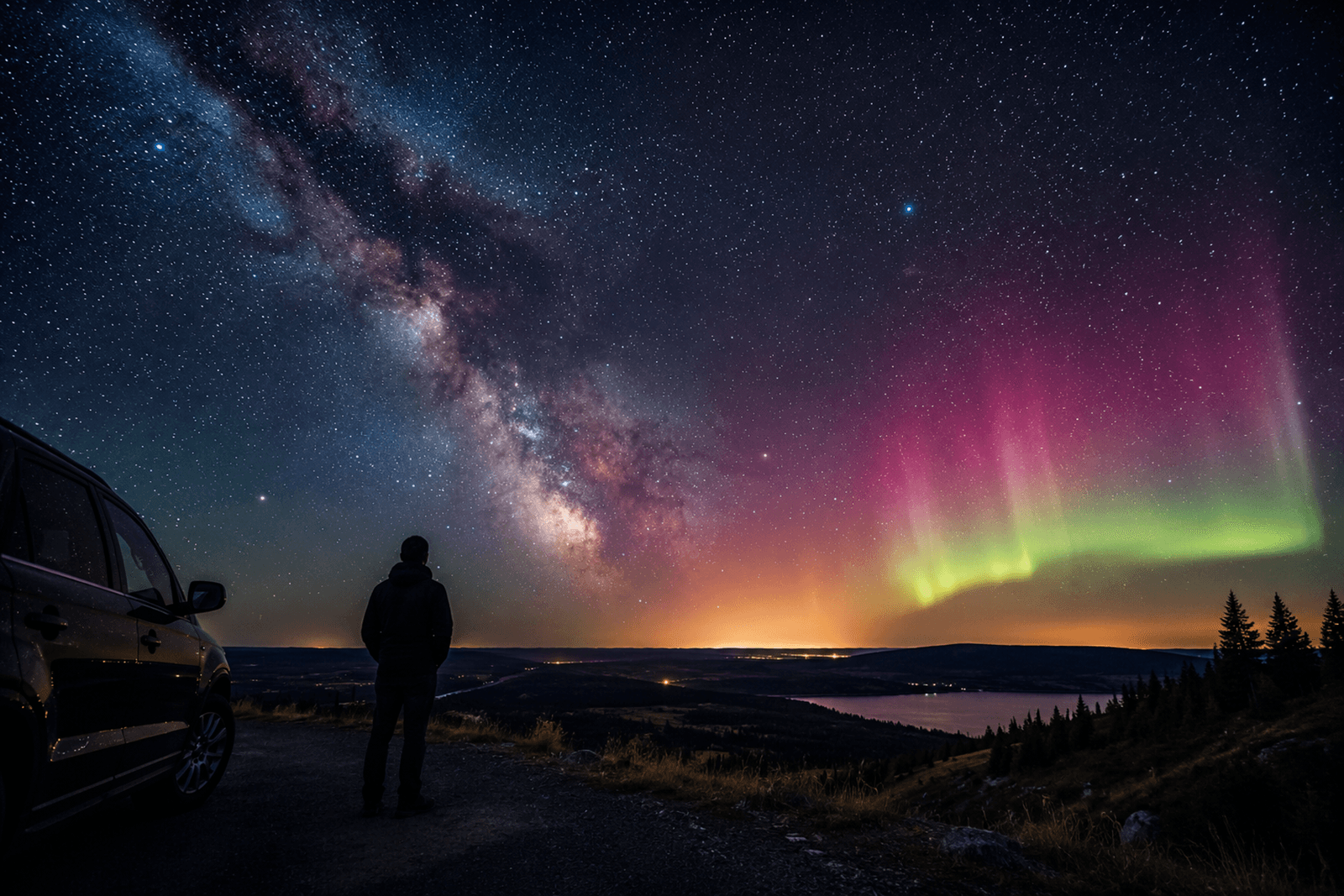
I grew up under a sky that most people never get to see.
For years I lived in rural North Dakota, the kind of place where the nearest streetlight was a rumor and the dark went on forever. You didn't have to plan for the night sky out there. You didn't have to drive anywhere or check an app or wait for the perfect conditions. You just walked outside, looked up, and there it was - stars scattered edge to edge, the moon bright enough to throw a shadow, planets steady and unblinking, and on the clearest nights, the Milky Way stretched across the whole sky like a road you could almost follow.
I remember standing out there in the cold, breath fogging, completely still. There's a particular kind of quiet that only happens under a truly dark sky. The world feels enormous and you feel small, but not in a bad way - in the way that puts things back in their proper size. "The heavens declare the glory of God; and the firmament shows His handiwork" (Psalm 19:1, NKJV). I didn't have the words for it back then. I just knew I was drawn to it, and that it gave me a kind of peace I couldn't find anywhere else.
Then I moved to the city
Life changes. These days I live in a large city, and the pace here is a different animal - busy, bright, constant. And the sky paid the price. Most nights now I step outside, look up out of old habit, and there's almost nothing. The moon, if I'm lucky. Maybe a planet or two punching through the glow. But the stars I grew up with are gone, washed out by a dome of light pollution that never really turns off.
For a while I just accepted it. That's the trade you make for living where the jobs and the people are, right? But I missed the dark sky more than I expected to. I missed the peace.
The problem I actually wanted to solve
Here's the thing about chasing a dark sky when you live in a city: it costs you time, gas, and effort. You have to drive out of town, away from the light, often an hour or more. And the worst feeling is doing all that work - packing up, making the drive, finding the spot - only to look up and find clouds, or a bright moon drowning everything out, or quiet skies when you were hoping for aurora.
I didn't want to gamble my limited free time on a hope. I wanted an advantage. I wanted to know, before I committed the time and resources, whether tonight was actually worth the trip. When is the aurora active? When are the skies clear? What can I see of the moon? Are there any visible planets? And where, exactly, is the nearest dark spot I can get to?
That's why I built Solar Ruler.
What I built it to do
I built the tools I wished I'd had - the ones that turn "I hope tonight is good" into "tonight is the night, let's go." Now, I know that these tools exist, but what I found was they were scattered across several sites, apps, and delivered in so many different ways. Some were helpful, others, not so much. I wanted a better tool, a better site that had it all in one place. That's what sruler.com is all about. A single place to go to gain a good understanding of what's happening in the sky wherever you are in real time.
The live aurora globe shows where the Northern and Southern Lights are right now, pulled from NOAA's real-time data. The 48-hour forecast slider lets me scrub ahead in time to see whether tonight, tomorrow, or the night after gives the best shot - so I can plan the trip instead of guessing. The cloud cover overlay answers the question that's ruined more night-sky outings than anything else: will I even be able to see the sky? And the dark sky finder points me toward the closest spots where the light pollution finally lets up. Alerts send you an email when it's likely you will be able to see the aurora (Northern or Southern lights) from your location, based on your Kp index selection. Tonight's Sky shares what's likely visible in the sky tonight (be sure to check cloud cover on the live aurora globe), including planets and known scheduled meteor showers. Solar weather provides a live view of the sun so you can see for yourself what may be coming in future solar weather patterns.
There's more on the site - dark skies, moon phases, live cams, eclipse tracking - but the heart of it is simple. Solar Ruler exists to help you spend your time and energy on the nights that are actually worth it, and to find that quiet, dark place from wherever you happen to live.
What comes next
I'll be honest with you: as I write this, I haven't yet taken Solar Ruler out on a real adventure of my own. I've built it, I've tested the data, and I believe in it - but the proof is in the chase.
So that's exactly what I'm going to do. Soon I'm heading out on my first real Solar Ruler adventure: using the forecast, picking the night, finding the dark spot, and seeing what the sky gives me. And I'm going to bring all of you along. I'll share photos, and video when I can, and walk you through how I used each tool to make the call - the good, the bad, and the lessons learned.
My hope is simple. Whether you live under endless prairie dark like I once did, or under a city glow like I do now, I want Solar Ruler to help you find your way back to a sky worth looking up at.
The stars are still there. We just have to know when and where to meet them.
Stick around - the first adventure is coming soon.